
The National Piano Guild Auditions: What They Are, How to Prepare, and Why They Matter
Posted on November 24, 2026
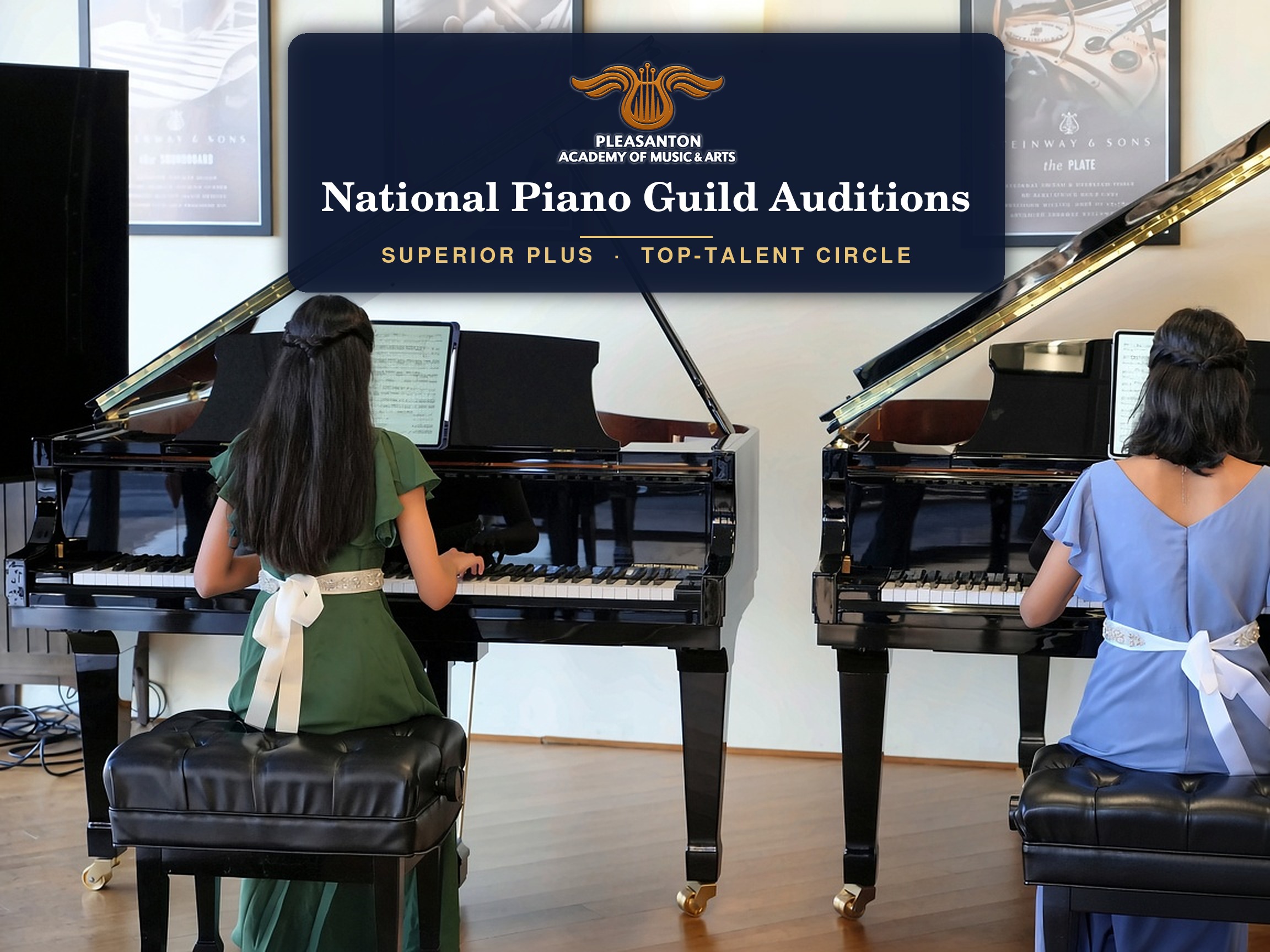
Once a year, thousands of piano students across the country sit down at a piano, alone with a single judge, and play a program they have memorized over many months. That is the National Piano Guild Auditions, run by the American College of Musicians / National Guild of Piano Teachers. It’s one of the oldest piano programs in the United States: the Guild was founded in 1929 and now has more than 850 audition centers.
This year, three students of Pleasanton Academy teacher Liya Ledyaeva showed what that preparation looks like.
Meet Our 2026 Guild Students
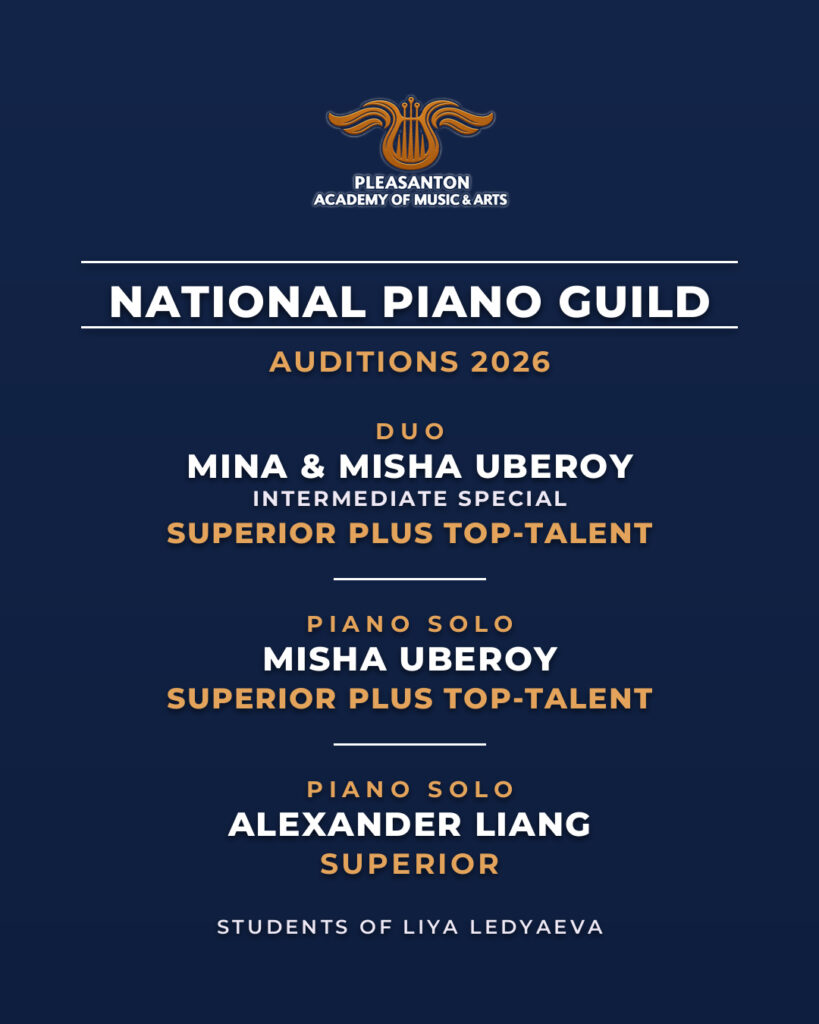
- Mina & Misha Uberoy, Piano Duo (Intermediate Special): Superior Plus, Top-Talent Circle
- Misha Uberoy, Piano Solo: Superior Plus, Top-Talent Circle
- Alexander Liang, Piano Solo: Superior
Superior Plus is the highest rating the Guild gives. It falls in the “Top-Talent Circle,” which the Guild describes as a pianist “qualified to perform anywhere before a critical audience.” A Superior rating is also an excellent result. It places a student in the Guild’s “Citywide Circle,” meaning a polished performance worthy of representing a school.
The duo’s “Intermediate Special” classification is the Guild’s category for exceptionally advanced students. It is meant for students whose repertoire runs well ahead of their level for their age and training. This isn’t a one-time success: Mina and Misha have earned Top-Talent Superior Plus recognition at the Guild over several years. They are also no strangers to big stages: they won 2nd Place at the United States International Piano Duo Competition in Colorado Springs.
“Guild preparation is a long journey. Students learn a whole program by memory, along with the scales for every piece, and that steady, consistent work is what builds real confidence at the piano.”
— Liya Ledyaeva, piano teacher, Pleasanton Academy of Music
So what does it take to get there?
How the Guild Auditions Work
No competition, just you and the judge
Guild auditions are non-competitive. Students are not ranked against each other. Each student plays privately for one qualified judge, and only the student and judge are in the room. The judge evaluates the student “on individual merit” in accuracy, continuity, phrasing, pedaling, dynamics, rhythm, tempo, tone, interpretation, style, and technique. The auditions take place once a year at local Guild audition centers across the country, and the Guild also offers online and video options. Pleasanton Academy does not host Guild auditions; our teachers prepare students and enroll them at a local audition center. Teachers enroll students early in the year (the Guild asks for enrollments preferably by February 1), and audition times are assigned after enrollment.
Choose your program size
Students choose how many pieces to play, and the program size sets the award level:
| Program | Memorized pieces |
|---|---|
| Pledge | 1 |
| Local | 2–3 |
| District | 4–6 |
| State | 7–9 |
| National | 10–14 |
| International | 15–20 |
Solo repertoire must be memorized and played in its entirety. Duet and duo programs are the exception: they don’t have to be memorized, but they also don’t count toward Guild scholarships and certain awards. Teachers have wide freedom to choose repertoire. Students are classified by difficulty, from Elementary A–F through Intermediate A–F, Preparatory A–D, and Collegiate A–D.
Scales and musicianship
Above the earliest level, every student also takes the IMMT (Irreducible Minimum Musicianship Test). This means playing scales and cadences in the keys of the pieces on the program. Students can also add optional Musicianship Phases, which count like extra “pieces.” The Phases cover scales, chords and cadences, arpeggios, ear training, transposition, improvisation, and sight-reading. The judge brings the sight-reading material.
How ratings work
The judge marks each piece and phase with “C” checks (special commendation) or “A” checks (needs attention). The rating comes from how many more C’s than A’s a student earns: Good, Very Good, Excellent, Excellent Plus, Superior Minus, Superior, and, at 28 or more extra C’s, Superior Plus (Top-Talent Circle).
Long-term goals
The Guild rewards consistency over many years. Students who play National or International programs (10+ memorized pieces) earn the Five-Year and Ten-Year National Roll, the Paderewski Gold Medal (10 programs), and the Irl Allison Gold Medal (15 programs). High school juniors and seniors can audition for the Guild High School Diploma. It is a demanding 90-minute program of 10 memorized pieces at an advanced level, including Bach, a complete Classical sonata, Romantic and contemporary works, and 5 Musicianship Phases. Students who combine ten National programs, the Paderewski Medal, and the High School Diploma can apply for a $200 Guild scholarship for continued piano study.
How to Prepare: A Practical Checklist
Students like Misha, Mina, and Alexander don’t get there in a few weeks. Here’s what preparation typically involves:
- Pick the right program size with your teacher. Most students build up over the years, from a Local or District program toward State and National. A smaller program played beautifully is better than a large one played under stress.
- Choose balanced repertoire early. Aim for contrasting styles and eras (Baroque, Classical, Romantic, contemporary) at a level that challenges the student without overwhelming them. Many teachers finalize the list by winter.
- Start memorizing early, and memorize deeply. Use several kinds of memory: hands, ears, eyes (the score), and understanding of the harmony and structure. Practice starting from different spots in each piece.
- Practice scales and cadences in every key on the program. The IMMT is required, so it should be part of daily practice, not a last-minute add-on.
- Consider Musicianship Phases. Phases in sight-reading, ear training, or transposition build skills that pay off far beyond the audition.
- Run full programs. Perform the whole program for family, friends, or in studio classes and recitals. Getting comfortable playing 10 or more pieces in a row takes rehearsal.
- Polish the details judges listen for: steady tempo, clean pedaling, real dynamic contrast, phrasing, and a beautiful tone.
- Think in years, not months. Each audition builds on the last. The Guild’s biggest honors reward students who return year after year.
“Practicing a little every day, and playing the full program for family at home, made a big difference. Each year the audition felt less stressful and more like a chance to share the music.”
— the Uberoy family
Guild vs. ABRSM vs. MTAC Certificate of Merit
Many of our students take more than one of these programs. Here’s how they compare:
| National Piano Guild | ABRSM | MTAC Certificate of Merit | |
|---|---|---|---|
| Run by | American College of Musicians / National Guild of Piano Teachers (Austin, TX) | Associated Board of the Royal Schools of Music (UK) | Music Teachers’ Association of California |
| Where | 850+ centers in the U.S. and abroad; online and video options | Internationally, including the U.S. | California |
| Format | Private, non-competitive audition with one judge | Graded exam with an examiner | Annual evaluation plus a written theory exam |
| Levels | Elementary through Collegiate; program size from 1 to 20 pieces | Grades 1–8, then performance diplomas (ARSM, LRSM, FRSM) | Preparatory, Levels 1–9, Advanced |
| Repertoire | Chosen by the teacher; solo pieces must be memorized | Three pieces from the syllabus lists, plus scales/arpeggios, sight-reading, and aural tests | Syllabus-based repertoire, technique, sight-reading |
| Theory | Optional Musicianship Phases; IMMT scales/cadences required | Grade 5 Theory (or an approved alternative) required before Grades 6–8 | Written theory and ear-training test at every level |
| Results | Ratings from Good to Superior Plus (Top-Talent Circle) | Marked out of 150: Pass 100, Merit 120, Distinction 130 | Certificate for passing; State Honors for top results |
| Standout honors | Paderewski Medal, High School Diploma, scholarships | Grade 8 Distinction, ARSM diploma | State Honors, Convention recitals, Panel and Young Artist Guild for Advanced students |
| Recognition | Long-standing and widely known among U.S. piano teachers | UK-regulated (Ofqual, on the RQF); Grades 6–8 carry UCAS points in the UK | Well known among California teachers and schools |
In short: the Guild emphasizes performance and memorizing a large repertoire, and rewards years of consistency. ABRSM is an internationally recognized, regulated qualification with a clear Grade 1–8 ladder. MTAC CM is a thorough California curriculum where theory and ear training carry real weight every year. They complement each other well.
How Valuable Is the Guild for a College Application?
Let’s be honest: no single music certificate will get a student into college on its own. But a strong, sustained Guild record can really strengthen an application.
- It shows long-term commitment. Admissions readers value depth over many years. A student with several National programs, a Paderewski Medal, or a Guild High School Diploma has clear, documented proof of that commitment.
- It fits naturally on the Common App. Piano study can go in the Activities section (years of participation, hours per week). Top ratings and awards such as Superior Plus, the Paderewski Medal, or the High School Diploma can go in the Honors section.
- It supports arts supplements. Many colleges accept optional music recordings or portfolios. The Guild repertoire a student has already memorized is a ready-made source for that recording. Check each college’s requirements.
- It pairs well with other credentials. ABRSM Grade 8 (especially with Distinction), CM Advanced or State Honors, and competition awards together tell a fuller story than any one program alone.
The Guild’s real value is what it builds: discipline, memory, poise under pressure, and a large repertoire played well. Those qualities show up in essays, interviews, and auditions too.
Frequently Asked Questions
Is the Guild a competition?
No. Students are judged individually against a standard, not against each other. Every student can earn a top rating.
How many pieces should a first-time student play?
It depends on the student. Many begin with a smaller Local or District program (2–6 memorized pieces) and grow from there. Your teacher will recommend the right size.
Can my child do the Guild and ABRSM or CM in the same year?
Yes, with planning. Repertoire can often overlap. Your teacher will help balance the timelines so neither program feels rushed.
Does the Guild include theory?
Every student plays scales and cadences (the IMMT). Ear training, sight-reading, transposition, and improvisation are optional Musicianship Phases. ABRSM and CM test theory more formally.
What does Superior Plus mean?
It’s the Guild’s highest rating, given when a student earns at least 28 more commendations than “needs attention” marks. It places the student in the Top-Talent Circle.
Start Your Own Journey
Inspired by Misha, Mina, and Alexander? Our teachers prepare students for the National Piano Guild Auditions (held at local audition centers), ABRSM, and MTAC Certificate of Merit, and help each family choose the path that fits their child.
Book a trial lesson (paid) at pleasantonacademyofmusic.com/contact-us or call (925) 200-6508.